
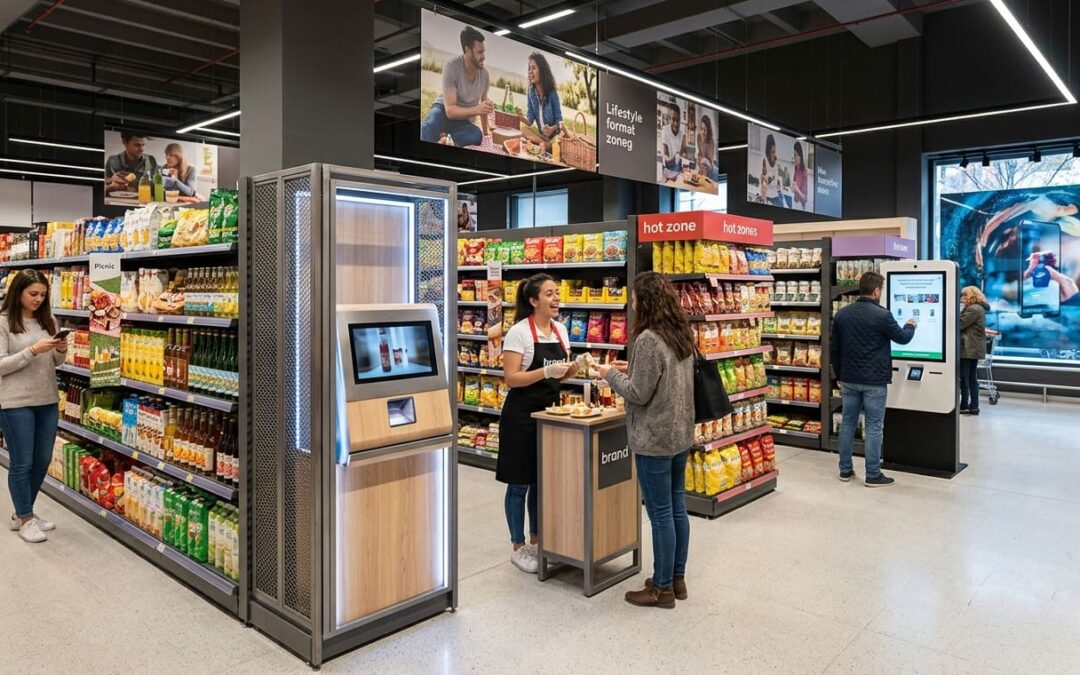
The point of sale remains the ultimate battleground for brands. It doesn’t matter how much you invest in digital: if your product goes unnoticed on the shelf, you are losing money. The brands that dominate retail don’t do so by chance. They apply proven strategies that combine creativity and flawless execution to turn every square metre into a conversion machine.
In this article we break down the 10 retail marketing strategies used by industry leaders, with real examples and practical applications so you can implement them in your own business. We’ll cover POS materials, activations, experiential retail, omnichannel strategy, personalisation and much more
1. High-impact POS materials: the first silent salesperson
Point-of-sale advertising (POS materials) is not just a cardboard display. Leading brands treat it as a strategic asset. A well-designed, well-placed POS element can increase a product’s sales by 20% to 30%, according to data from POPAI (now Shop! Association).
What do leading brands do differently? They design multi-material POS displays that combine functionality with visual impact. They don’t stop at cardboard: they integrate wood, metal, LED lighting and even digital screens to create elements that stand out from the visual noise of a crowded shelf.
The key lies in three factors: strategic placement (gondola ends, central islands, checkout area), consistency with the brand’s visual identity and ease of installation for store staff. If a shop assistant can’t put it together in five minutes, it will probably end up in the stockroom.
Grupo WDi designs and manufactures multi-material POS displays that maximise brand visibility at the point of sale, with solutions tailored to each distribution channel.
2. Brand activations at the point of sale
Activations go one step beyond static POS materials. They are about creating a moment of interaction between the consumer and the brand, right where the purchase decision is made. Tastings, product demonstrations, instant-reward promotions or sensory experiences: it all counts.
What separates a good activation from a mediocre one is planning. Top brands follow a clear process:
They define the objective (sell-out, customer acquisition, branding, product rotation)
They select the points of sale with the highest footfall and affinity
They train promotional staff to be genuine brand ambassadors
They measure results in real time with specific KPIs
An activation without measurement is just an event. With data, it becomes an investment with a calculable return.
3. Strategic visual merchandising
Visual merchandising is not decoration. It is the science of organising retail space to guide the customer journey and maximise exposure to the highest-margin products. Major chains invest millions in optimising their planograms because they know every centimetre of shelf has an economic value.
The rules professionals apply include the “hot zone” (the area customers see first when they walk in), eye level as the premium position, and grouping products by consumption occasion rather than rigid categories. A smart retailer groups barbecue items with craft beer and tableware, rather than splitting them across three different aisles.
4. Real omnichannel strategy (not just lip service)
Omnichannel stops being a trend and becomes the norm in 2026. But there is a huge difference between saying you are omnichannel and actually being so. Brands that get it right integrate the physical and digital experience seamlessly: customers can see a product online, try it in store, buy it on their phone and collect it two hours later.
The component many brands overlook is visual and promotional consistency across channels. If your website shows an offer the store knows nothing about, you have broken the experience. Leading brands synchronise their trade marketing campaigns across every touchpoint, from the shop window to the confirmation email.
5. Experiential retail: selling feelings, not just products
The 2026 consumer doesn’t buy products, they buy experiences. Brands that turn their points of sale into experiential spaces achieve longer dwell times, more engagement and, as a direct consequence, a higher average basket value.
How does this take shape? Through themed spaces, product trial areas, immersive technology (augmented reality in fitting rooms, interactive screens on shelves) and carefully crafted sensory ambience: music, lighting, scent. The goal is for customers to associate the brand with a positive emotion that goes beyond the product itself.
Discover how Grupo WDi creates retail spaces and brand experiences that connect with the end consumer.
6. Personalisation at the point of sale
Personalisation is no longer exclusive to the digital world. Brands that excel in retail use data from their loyalty programmes, apps and CRM to deliver personalised experiences in store too. From geolocated offers that reach the customer’s phone as they walk in, to recommendations on digital screens based on purchase history.
The level of sophistication varies, but even simple actions such as adapting the product range to local demographics or tailoring signage to the season and geographical location make a significant difference to conversion.
7. Smart promotions with mechanics that drive repeat purchase
Promotions still work, but sophisticated brands have moved on from simple discounts to designing mechanics that build buying habits. Points schemes, cashback, gifts for accumulated purchases, prize draws linked to repeat purchase: the key is that the promotion doesn’t erode margin but builds a long-term relationship.
Good end-to-end management of promotional campaigns covers everything from creative design and materials production to promotional logistics, legal management and communication with participants.
8. Window dressing and signage as conversion tools
The shop window is the first advert the consumer sees, and it’s free. Yet many brands underestimate it. Major chains change their windows at least every two weeks and design them with the same strategy as an advertising campaign: a clear message, a visible value proposition and a call to action that invites people in.
In-store signage plays a similar role. Good wayfinding doesn’t just orient customers; it guides them towards the areas of greatest commercial interest. Totems, illuminated 3D letters, large-format vinyls and props create a customer journey that maximises exposure to strategic products.
9. Field marketing and street teams
Taking the brand outside the store remains one of the most effective strategies for building awareness and driving footfall to the point of sale. Leading brands combine street marketing, sampling in high-traffic areas and participation in local events with flawless logistics.
The difference between a successful field marketing campaign and one that passes without impact lies in the selection and training of the team. Promotional staff must know the product, understand the brand’s values and be able to connect with the public in seconds. The production and logistics of these actions require a level of coordination that only specialist agencies can guarantee consistently.
10. Data analysis and retail media as a competitive advantage
The final strategy, and perhaps the most transformative, is the use of data to make decisions at the point of sale. Major brands no longer launch campaigns based on intuition: they analyse sell-out data, in-store heat maps, conversion rates by location and the performance of each POS element to optimise continuously.
Retail media, meanwhile, has exploded as an advertising channel. Brands pay retailers for advertising space within their platforms (both physical and digital), turning the point of sale into an owned media channel with a captive audience.
| Strategy | Main objective | Investment level | Sales impact |
| High-impact POS materials | Visibility | Medium | High |
| Point-of-sale activations | Sell-out / Engagement | High | Very high |
| Visual merchandising | Conversion | Low/Medium | High |
| Omnichannel | Integrated experience | High | High |
| Experiential retail | Branding / Average basket | High | Medium/High |
| Personalisation | Conversion / Loyalty | Medium | High |
| Smart promotions | Repeat purchase | Medium | High |
| Window dressing | Footfall | Low | Medium |
| Field marketing | Awareness / Footfall | Medium/High | Medium |
| Retail media + Data | Continuous optimisation | High | Very high |
The professional’s perspective: what really makes the difference
After more than a decade working with leading brands in retail and trade marketing, one pattern keeps repeating itself: the brands that achieve the best results are not the ones that invest the most, but the ones that execute best. And flawless execution requires a partner who manages the entire process end to end, from creative design to in-store installation, including production, logistics and results measurement.
The most common mistake is fragmenting the chain across multiple suppliers. When the designer doesn’t talk to the manufacturer, and the manufacturer doesn’t coordinate with the installation team, the end result never lives up to the original brief. An integrated service is not a luxury: it is what separates mediocre executions from those that generate a real return.
Frequently asked questions
What is retail marketing and how does it differ from trade marketing?
Retail marketing covers all marketing actions aimed at the end consumer in the retail environment. Trade marketing focuses on the relationship between the brand and the distributor. The two complement each other: trade marketing opens the retailer’s door and retail marketing wins over the shopper.
How much does it cost to implement a POS strategy for a brand?
It depends on the scope. A POS campaign with cardboard elements for 50 points of sale can start from a few thousand euros. Projects involving permanent multi-material store fixtures for national chains can exceed 100,000 euros. What matters is calculating the ROI per unit sold.
Which retail marketing strategy works best for small brands?
Point-of-sale activations and visual merchandising offer the best return on limited budgets. They allow you to stand out against larger competitors without the need for major infrastructure investment.
How do you measure the success of a retail marketing campaign?
The key KPIs are the increase in sell-out during and after the campaign, the footfall generated, the cost per acquisition and the visibility achieved (measured as the number of correct implementations vs. planned).
Do you need to hire a specialist retail marketing agency?
It’s not essential, but it is highly recommended for multichannel campaigns or those rolled out across multiple points of sale. An agency with experience in event management and activations brings infrastructure, a network of contacts and execution capacity that would be very costly to replicate in-house.
Which retail marketing trends will dominate in 2026?
The integration of artificial intelligence into in-store personalisation, the rise of retail media as an advertising channel, sustainability in POS materials and the complete fusion of physical and digital experiences (phygital) are the four trends already redefining the sector.
Conclusion
Retail marketing in 2026 can no longer be approached with isolated formulas. Winning brands combine high-impact POS materials, experiential activations, real-time data and seamless omnichannel execution. Technology is advancing and consumers are more demanding, but the fundamental principle remains intact: whoever dominates the point of sale dominates the sale.
If your brand needs a partner to manage the entire retail marketing process end to end, from strategy to in-store execution, get in touch with Grupo WDi and start turning every point of sale into a real competitive advantage.