
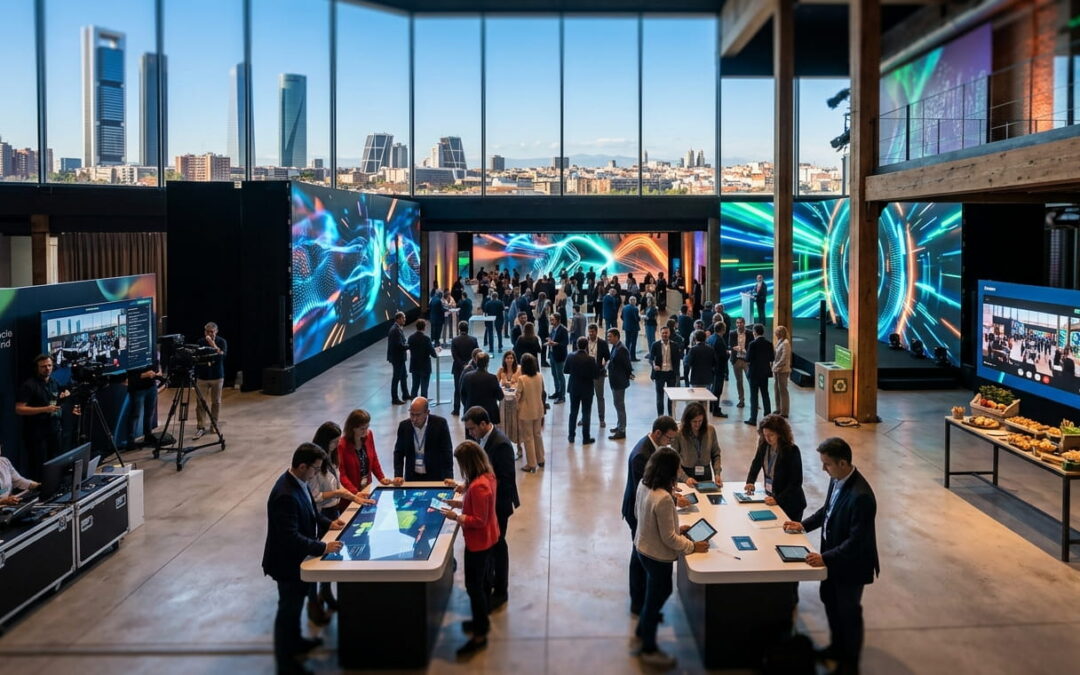
Madrid has established itself as one of Europe’s most attractive cities for corporate events. First-class hotel infrastructure, a range of venues spanning historic palaces to converted industrial spaces, world-renowned gastronomy and a climate that allows outdoor events for much of the year. It is no coincidence that MICE tourism (Meetings, Incentives, Conferences, Exhibitions) accounts for a growing share of Madrid’s economy.
But organising a corporate event in Madrid in 2026 is not the same as it was five years ago. Attendee expectations have changed. Technology has opened up possibilities that used to be science fiction. Sustainability has gone from a “nice to have” to a non-negotiable requirement. And the competition for attention is fiercer than ever.
In this article we look at the trends shaping corporate events in Madrid this year, the practical keys to organising them successfully and the mistakes you should avoid.
The state of the sector: why Madrid leads in corporate events
Madrid does not lead by chance. The city brings together a combination of factors that puts it ahead of most European capitals in the MICE segment.
Air connectivity is exceptional. Adolfo Suárez Madrid-Barajas Airport connects with more than 200 international destinations, making it easy for participants to attend from anywhere in the world. On top of that, the AVE high-speed rail network links Madrid with Barcelona, Seville, Valencia and Málaga in under three hours.
The choice of spaces is huge and varied. From IFEMA Madrid (one of the largest trade fair centres in Europe) to boutique hotels with private function rooms, country estates 30 minutes from the city centre, museums, rooftops overlooking Gran Vía and industrial buildings in Matadero or the Distrito de las Artes. There is a venue for every type of event and every budget.
And Madrid’s gastronomy adds a distinctive touch. Corporate events in Madrid can offer world-class culinary experiences as part of the programme, something international attendees value enormously.
Trends shaping corporate events in 2026
1. Experience over information
The corporate events that work in 2026 are not conferences with endless slide decks. They are experiences designed to create an emotional connection with the brand, the product or the message. The traditional “speaker talks, audience listens” format is being replaced (or at least complemented) by participatory dynamics, hands-on workshops, immersive experiences and purpose-designed networking moments.
The brands that get it right design every event as a narrative with a beginning, a middle and an end. Every element (the venue, the catering, the lighting, the music, the activities) reinforces a central message. They are not decorative details: they are storytelling tools.
2. Integrated (not cosmetic) sustainability
Sustainability in events has moved beyond the “greenwashing” phase. Attendees, sponsors and employees themselves demand genuine consistency. That means choosing venues with energy certification, locally sourced catering with plant-based options as standard (not as an exception), keeping printed materials to a minimum, offsetting the carbon footprint of travel and managing waste responsibly.
Companies that run sustainable events do not do it just for their image: the data shows that events with a documented environmental commitment generate higher attendee satisfaction and better media coverage.
3. Optimised hybrid format
The hybrid format (in person + streaming for remote attendees) has become established, but it has evolved. It is no longer enough to set up a camera and broadcast. Hybrid events in 2026 design distinct experiences for each audience: in-person attendees enjoy the full event, while remote attendees access an adapted format with exclusive content, real-time interaction and facilitated virtual networking.
The technology has matured enough for the digital component to be not a “plan B” but a channel in its own right, one that extends the event’s reach without diluting the in-person experience.
4. Personalisation at scale
Mass events with the same message for everyone are giving way to segmented experiences within the event itself. Parallel tracks for different profiles, customisable agendas, on-demand content and matchmaking systems that connect attendees with shared interests.
Registration technology and event apps make it possible to collect attendee data before, during and after the event to personalise the experience: from recommended sessions to suggested contacts, and even the lunch menu.
5. High-end stage production
Event production (set design, lighting, sound, AV, staging elements) has stepped up dramatically. Attendees, used to high-end productions on Netflix, at concerts and in immersive experiences, expect the same from a corporate event. A stage with a lectern and a projector is no longer enough.
Today’s productions combine projection mapping, large-format LED screens, programmable stage lighting, surround sound and props that turn the venue into a fully immersive space.
The most in-demand types of corporate events in Madrid
Conventions and company meetings
The classic that never goes out of fashion, but reinvents itself every year. Sales conventions, seasonal kick-off meetings and annual employee gatherings remain the most requested format. The difference is that they are now designed with experiential components that used to be reserved for consumer events.
Product launches
Madrid offers an ideal ecosystem for high-impact launches: spectacular venues, access to national and international media, proximity to influencers and content creators, and a sophisticated consumer base. A good launch in Madrid can generate national and international coverage in a single day.
Trade fairs and congresses
IFEMA Madrid hosts some of the most important trade fairs in Europe. Taking part with a stand that stands out among hundreds of competitors requires flawless planning and execution: stand design, manufacturing, materials logistics, installation, staffing and dismantling. All within very tight deadlines and with no margin for error.
Grupo WDi handles stand design, manufacturing and installation for trade fairs and congresses, with a team that ensures quality, speed and safety on every project.
Press and influencer events
Breakfasts, brunches, exclusive dinners or experiences designed to generate media coverage and social content. The format is smaller in scale but more carefully crafted in every detail: the setting, the culinary experience, the press materials and the visual storytelling that makes it easy for attendees to share quality content on their channels.
Team building and incentives
Internal events focused on team cohesion and motivation have evolved beyond the usual adventure activities. Companies are looking for purposeful experiences that reinforce corporate values, generate learning and, at the same time, are memorable. From cookery workshops to private cultural experiences or creative challenges with social impact.
Practical keys to organising a successful corporate event in Madrid
Define the objective before the format
It sounds obvious, but it is the most common mistake. Many companies decide they want to “do an event” before defining what they want to achieve with it. Motivate the sales team? Position the brand with the media? Close commercial deals? Present a product? The objective determines the format, the venue, the budget and even the day of the week.
Choose the right venue (not the prettiest one)
The space has to serve the event, not the other way round. A spectacular venue with poor acoustics, no parking, far from public transport or with the wrong capacity can ruin any event. The key questions are: is the capacity right? Is the location accessible for attendees? Does the technical infrastructure (sound, lighting, connectivity) meet your needs? Is the venue team collaborative and flexible?
Invest in production, not decoration
There is a huge difference between “decorating” an event and “producing” an event. Decoration is superficial. Production is structural: it includes set design, the design and manufacture of installation elements, AV, professional lighting and technical coordination. A well-produced event runs like clockwork and makes an impact. A “decorated” event may look nice in photos but fail at the essentials.
Treat logistics as seriously as content
Invisible logistics are what make an event flow or grind to a halt. Guest transfers, accreditation management, supplier coordination, the timing of each segment, a plan B for the unexpected, materials logistics and storage. End-to-end event production management requires meticulous coordination among dozens of players, and a single failure in the chain can affect the entire experience.
Select and train your staff
Event staff (hosts, coordinators, technicians, guides, crew) are the visible face of the brand during the event. Their attitude, their product knowledge and their ability to handle the unexpected make the difference between a smooth experience and one full of friction. Selecting, hiring and training staff is an investment, not an expense.
What sets a memorable event apart from a forgettable one
After years of organising and producing corporate events for brands across different sectors, the conclusion is clear: the events attendees remember (and that deliver measurable results for the company) share three characteristics.
First, they have a clear message that runs through every element of the event, from the invitation to the follow-up afterwards. Second, they surprise with at least one unexpected moment that breaks attendees’ expectations (a guest artist, an activity no one saw coming, a twist in the programme). And third, they are executed with a professionalism that makes everything look easy, even though months of planning and coordination lie behind it.
The difference is never the budget. Events with modest budgets outperform others with million-euro investments simply because they are better thought out, better coordinated and executed with greater attention to detail by experienced professionals.
Frequently asked questions
How much does it cost to organise a corporate event in Madrid? The range is enormous. A press breakfast for 30 people can cost between €3,000 and €8,000. A convention for 200 employees with stage production, catering and entertainment can come in at between €30,000 and €100,000. Large events with more than 500 attendees and high-end production can exceed €200,000.
How far in advance should I start planning a corporate event? For medium-sized events (50 to 200 people), 3 to 4 months. For large events or those with complex components (international trade fairs, conventions with high-profile speakers), 6 to 12 months.
Which Madrid venues do you recommend for corporate events? It depends on the format. IFEMA Madrid is the benchmark. For exclusive events, venues such as Palacio de Neptuno, La Casa Encendida or spaces in the Barrio de las Letras offer a distinctive touch. For outdoor events, country estates in the Sierra de Madrid or rooftops in the Chamberí and Salamanca districts are popular options.
Is a hybrid event worth it in 2026? Yes, as long as the digital experience is designed as a channel in its own right and not simply as a stream of the in-person event. The additional costs of hybrid production are justified when you significantly extend your reach without sacrificing quality.
What should an event agency proposal include? A good proposal sets out: the creative concept, programme planning, venue selection (with alternatives), a budget broken down by item, the assigned team, a production plan with a timeline and proposed success metrics. Be wary of proposals that talk a lot about creativity and little about execution.
Conclusion
Corporate events in Madrid are at their best in 2026. The city offers first-class infrastructure, talent and a supplier ecosystem. But organising an event that genuinely makes an impact takes much more than booking a venue and hiring a caterer.
Trends point towards experiences that are more immersive, more sustainable, more personalised and with ever higher production values. The brands that seize this opportunity build stronger relationships with their customers, employees and stakeholders.
If your company needs to organise a corporate event in Madrid that leaves a lasting impression, get in touch with Grupo WDi. We design, produce and deliver standout events with an end-to-end approach: from the creative idea to the very last detail of execution.