
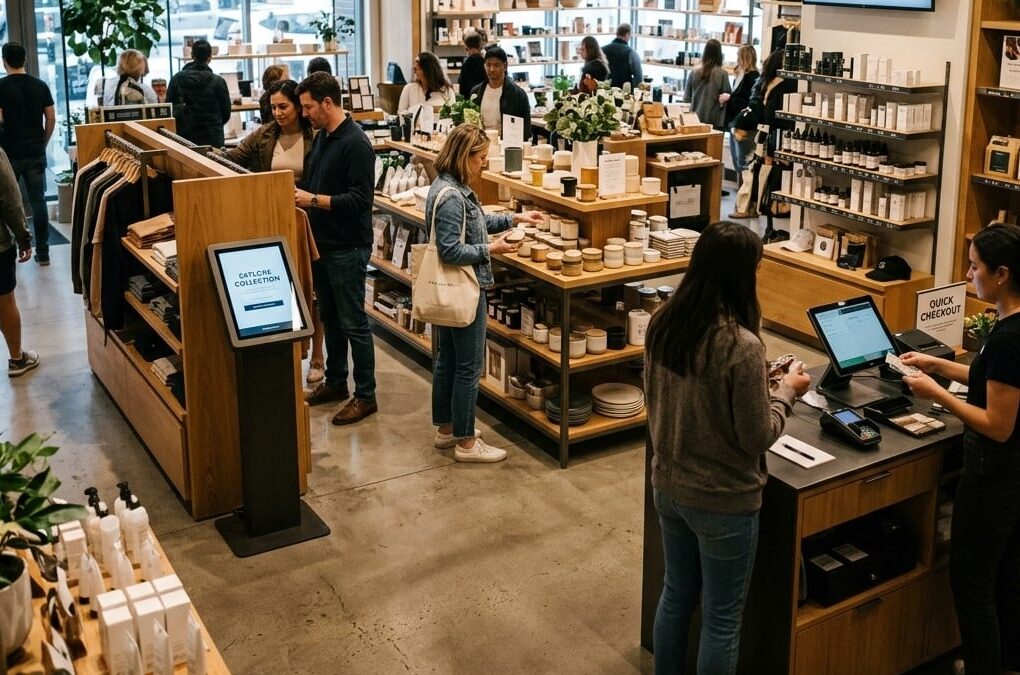
Retail marketing is the set of strategies and commercial actions a brand applies in and around the physical point of sale to influence the customer’s purchase decision at the exact moment they are standing in front of the product. It covers everything from store design and point-of-sale advertising (POS materials) to the sensory experience, staff training and in-store technology. Its ultimate goal is simple: turn visits into sales and build shopper loyalty. Companies such as Grupo WDi specialise in designing and implementing these strategies for brands that want to stand out in an increasingly competitive retail environment.
For years, marketing has focused almost exclusively on the digital environment, leaving in the background a space that is still decisive: the physical shop. Yet industry data confirms that most purchase decisions are still made inside the store, not beforehand. This makes the point of sale the last and most important touchpoint between brand and consumer.
What retail marketing is and why it is key to increasing in-store sales
Understanding retail marketing means going beyond simply dressing a shop window. It is a discipline that combines consumer psychology, space design, visual communication and data analysis to guide the customer’s journey through the store. Every element, from the lighting to the way products are laid out, serves a strategic purpose designed to make buying easier.
Brands that invest in retail marketing achieve measurable results: longer dwell time in store, a higher average basket value and an improved brand perception. It is no coincidence that the most successful retail chains allocate specific budgets to this area, treating it as seriously as their digital strategy.
A good example of this integration is the way brands combine their point-of-sale marketing with digital campaigns, creating a consistent experience between the online and physical worlds. This omnichannel connection is now one of the biggest drivers of customer loyalty.
Point-of-sale advertising (POS materials) and its role in conversion
Point-of-sale advertising, often referred to as POS materials, is one of the most powerful tools in retail marketing. It consists of physical elements such as displays, gondola ends, stands or custom fixtures that communicate the brand message right at the moment of the purchase decision.
The effectiveness of POS materials depends directly on the quality of their design and manufacture. A poorly built or unattractive display can go completely unnoticed, whereas a well-conceived one grabs attention in seconds and draws the customer’s eye towards the product. That is why more and more brands rely on suppliers specialising in POS display production, able to manufacture durable, sustainable pieces aligned with the brand’s visual identity.
Sustainability, in fact, has become an increasingly decisive criterion. Many brands now ask for recyclable or low-impact materials for their displays, a topic you can explore further in this guide to sustainable POS materials.
The elements of an effective retail marketing strategy
A complete retail marketing strategy is not limited to a single, isolated element; it brings together different layers of work that reinforce one another:
- Layout design and customer flow within the point of sale.
- Visual communication through POS materials, signage and wayfinding.
- Training and motivating the in-store sales team.
- One-off promotional activations and events.
- Integration with digital channels for an omnichannel experience.
Each of these elements requires specific planning depending on the sector, the type of store and the shopper profile. For example, strategies aimed at children tend to rely on more playful, sensory experiences, an approach developed by specialists in family marketing.
Activations and events also play a prominent role in retail marketing, as they create moments of direct interaction between brand and consumer. When well executed, these actions generate an emotional impact that strengthens brand recall long after the store visit. You can see real examples of this kind of work in our project portfolio.
Why retail marketing is still key in the digital age
You might think that, with the rise of e-commerce, retail marketing is losing relevance. The reality is quite the opposite. Today’s consumers research online but still buy largely in physical stores, especially in categories such as fashion, food, electronics and FMCG. This forces brands to look after every detail of the point of sale as if it were an extension of their website or app.
What is more, the physical shop offers something the digital environment cannot replicate: the full sensory experience. Touching the product, trying it, smelling it or simply feeling the atmosphere of the store creates an emotional bond that directly influences the purchase decision and long-term loyalty.
Brands that understand this invest in specialist agencies capable of designing 360 strategies that cover everything from overall marketing services to hands-on execution in each store. This integrated approach is what makes the difference between a one-off action and a truly profitable retail marketing strategy.
Common mistakes when applying retail marketing
Many brands invest time and budget in retail marketing but do not get the results they expect because they make mistakes that could easily be avoided. One of the most common is copying trends from other sectors without adapting them to the real profile of the customer who visits the store. What works in a young fashion shop may make no sense at all in a household appliance store or a specialist food shop.
Another common mistake is treating the point of sale as a static element that is designed once and never reviewed again. Consumer behaviour changes, visual trends evolve and competitors innovate too. That is why the most effective retail marketing strategies are reviewed and updated regularly, based on real in-store behaviour data rather than one-off aesthetic decisions.
It is also common to see brands invest in eye-catching POS materials but neglect sales team training, or, conversely, train their staff very well but keep an outdated point of sale. Retail marketing works best when all these elements move forward in a coordinated way, not as isolated initiatives.
Current trends in retail marketing
Retail marketing is constantly evolving, shaped by changes in consumer behaviour and the emergence of new technologies. One of the most relevant trends today is the personalisation of the in-store experience, supported by data that allows promotions or messages to be tailored to the customer’s profile.
Sustainability is another trend that is no longer optional and has become a genuine purchase criterion, especially among younger consumers. Brands that use recyclable or low-impact materials in their POS materials not only reduce their environmental footprint but also reinforce a perception of responsibility in the customer’s eyes.
Finally, the integration of physical and digital channels continues to gain ground. Services such as click and collect, virtual fitting rooms and frictionless payment systems are redefining what consumers expect from a modern in-store shopping experience.
How to start applying retail marketing in your business
If you are considering bringing retail marketing strategies into your business, the first step is to analyse your current point of sale from the customer’s perspective. Ask yourself what they feel, what they see first and what stops them buying or makes it easier. From there, it is advisable to work with specialists who can identify specific opportunities for improvement.
It is not about investing large budgets all at once, but about prioritising actions with real impact: improving signage, renewing key fixtures, training the store team or introducing POS materials at strategic points. Over time, these improvements translate into a sustained increase in sales and a more satisfying shopping experience for the customer.
Knowing what retail marketing is and why it is key to increasing in-store sales allows you to make better-informed decisions about where to invest your commercial budget. The combination of design, technology and strategy remains, today more than ever, one of the pillars of physical retail. If you would like to analyse the potential of your point of sale, you can contact our team, or read more articles like this one on the Grupo WDi blog.
Frequently asked questions about retail marketing
What is the difference between retail marketing and traditional marketing? Traditional marketing aims to build brand awareness and demand through mass media, whereas retail marketing works specifically at the point of sale to turn that demand into an actual purchase.
What role do POS materials play in retail marketing? Point-of-sale advertising is one of the main tools of retail marketing, as it communicates the brand message right at the moment the customer decides what to buy.
Is investing in retail marketing worthwhile for an SME? Yes. Even with limited budgets, it is possible to make specific improvements to signage, product layout or staff training that deliver a measurable return in sales.
Does retail marketing only apply to large physical stores? No. It applies to any physical point of sale, from small specialist shops to hypermarkets, adapting the strategy to the scale and type of business.
How is the success of a retail marketing strategy measured? Through indicators such as an increase in average basket value, dwell time in store, conversion rate and repeat purchase.