
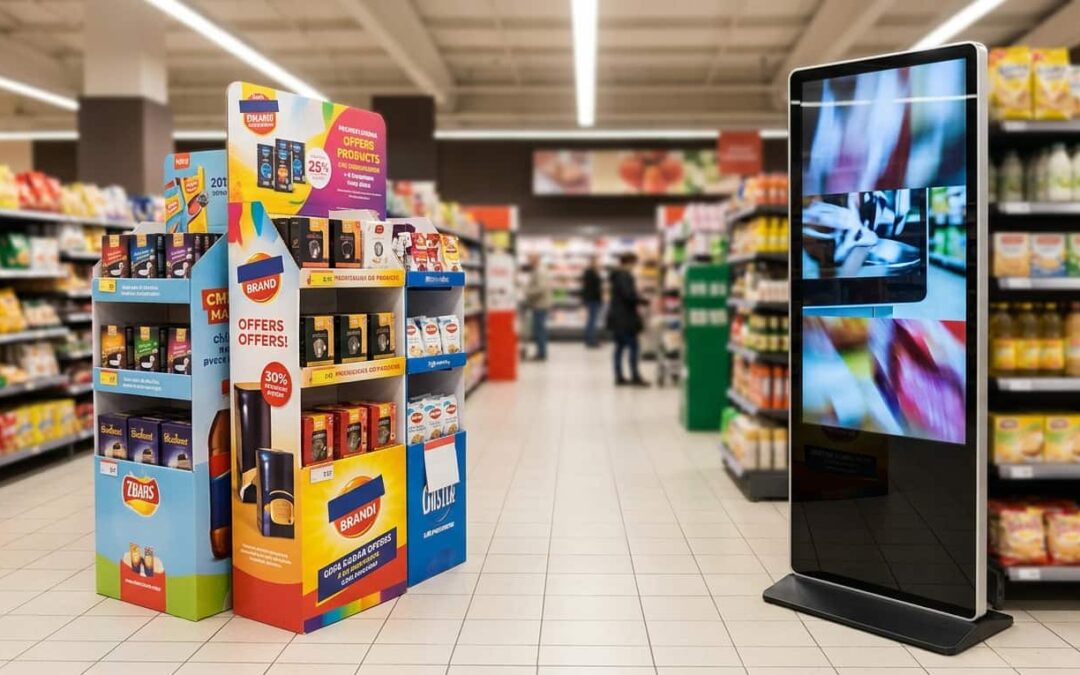
Point-of-sale advertising has evolved considerably in recent years. Where once there were only cardboard displays, acrylic totems and printed banners, today these sit alongside high-resolution screens, interactive displays and dynamic signage that updates its content in real time. This raises a legitimate question for any marketing or trade marketing manager: when does it make more sense to go with traditional POS materials, and when is it worth making the leap to digital POS? There is no single answer; it depends on factors ranging from budget and channel to consumer profile and the specific objectives of each campaign.
What do we mean by traditional POS materials?
Traditional POS materials are any physical items designed to communicate at the point of sale without needing a power supply or digital infrastructure. They include floor and counter displays, posters, shelf stoppers, printed totems, banners, wobblers, promotional islands and any other element produced from materials such as cardboard, wood, metal, PVC, polymers or vinyl.
It is the format with the longest history in retail and remains the most widespread for objective reasons. It requires no electrical installation or technical maintenance, can be produced in large volumes at manageable costs, works in any type of store and allows almost unlimited freedom in terms of shapes, textures and finishes. When we talk about a wide-coverage campaign that must be present in hundreds or thousands of points of sale at the same time, traditional POS materials are, in most cases, the only viable option from a logistical and financial point of view.
What digital POS is and how it differs
Digital POS is any point-of-sale communication element that uses electronic technology to display content. This includes LED screens, LCD displays, interactive digital totems, projections or signage synchronised through remote content management software. It also covers hybrid solutions that combine a physical structure with an integrated digital element.
The fundamental difference from traditional POS materials is not just visual. It lies in the flexibility of the content: a screen can show different messages at different times of day, update prices in real time, play videos, respond to user interaction or integrate with data systems to personalise communication. All without having to reprint or redistribute any physical material.
Advantages of traditional POS materials
Traditional POS materials remain irreplaceable in many scenarios because they offer advantages that the digital version cannot match in those particular circumstances.
The production cost per unit is significantly lower when working with large volumes. A national campaign that requires simultaneous presence in thousands of stores can be delivered efficiently and in a controlled way with physical POS materials, something that is financially unfeasible with screens.
Nor does it need any kind of in-store infrastructure. There is no need to worry about the availability of power sockets, internet connectivity or hardware maintenance. The piece arrives, is installed and works.
From a design point of view, traditional POS materials allow shapes and configurations that the digital version cannot replicate. A die-cut cardboard display with a special geometry, a cardboard island with a complex structure or a wooden display with bespoke finishes are solutions that combine physical presence with brand identity in a unique way. In our point-of-sale visibility and POS materials services, we regularly work with physical materials for leading brands that need simultaneous presence across multiple distribution channels.
Advances in sustainable materials have also opened up new possibilities for traditional POS. Today it is possible to produce materials of high visual quality with a reduced environmental impact, something many leading brands value as a strategic part of their image.
Advantages of digital POS
When the context allows and the objectives justify it, digital POS offers possibilities that the traditional version simply cannot cover.
Updating content at no additional production cost is the standout advantage. A screen installed at the point of sale can change its message according to the time of day, the week, the season or any other predefined criterion, with no additional printing, no transport and no need for a physical visit to the store.
The ability to communicate with movement is another significant difference. Movement in a static environment attracts attention almost automatically. A product video, a brand animation or a visual demonstration generates a level of attention that printed material rarely achieves under the same conditions.
In permanent or long-term installations, digital POS can be more cost-effective than traditional POS in the medium term. The initial investment in hardware pays off if the content is updated frequently and the screen stays active for an extended period. Our digital communication services for brands take these factors into account to help brands make the right decision on every project.
When to choose traditional POS materials
Traditional POS materials are the most suitable option when the campaign requires mass presence across many points of sale at the same time, when the budget does not allow for investment in digital hardware, when the store lacks adequate electrical infrastructure, when the piece has a short and well-defined lifespan, or when the design calls for shapes or textures that are only possible with physical materials.
FMCG, food, pharmacy and household goods are the sectors that typically get the most out of traditional POS materials, given their distribution conditions and the number of points of sale they need to cover. Our POS manufacturing and installation team manages every stage of the process, from production to nationwide distribution to stores, with quality control on every delivery.
When to go for digital POS
Digital POS makes most sense when the installation is permanent or long-term, when the content needs to be updated frequently, when the brand wants to project an image of innovation or premium positioning, when the point of sale has the necessary infrastructure, or when the brand has high-quality audiovisual content that deserves to be shown in motion and with maximum visual impact.
Fashion, technology, luxury cosmetics, automotive and specialist retail are the sectors that typically get the most out of digital POS, both because of their target audience and the type of store in which they operate.
Opting for a hybrid approach
On many projects, the smartest answer is not to choose between digital and traditional POS, but to combine them. A physical structure made of wood or metal with a built-in screen is a clear example of a hybrid approach: it keeps the brand’s physical presence and tactile identity while adding the ability to communicate with movement and updatable content.
This type of solution is particularly well suited to corners or shop-in-shops in hypermarkets and department stores, to high-visibility areas within a retail space, or to product launches where the brand experience plays a leading role. You can see how we have tackled these kinds of challenges in our portfolio of POS and retail projects with brands from different sectors and with different levels of distribution.
In any case, the key is to start from the objectives and the real installation context before deciding on the format. If you are unsure which type of POS best suits your next campaign, talk to our team and we will help you find the most effective solution for your brand.
Frequently asked questions about digital and traditional POS
Is digital POS always more expensive than traditional POS?
Not necessarily in the long run. The cost per impression can be lower with digital POS when the screen is used over an extended period and the content is updated frequently. The upfront cost is higher, but profitability depends directly on how long it is used and how often the content is refreshed.
Can digital and traditional POS coexist at the same point of sale?
Yes, and in many cases it is the most advisable solution. Both formats can complement each other to meet different communication objectives within the same space, with each format assigned the role in which it is most effective.
How long does it take to produce a traditional POS campaign?
It depends on the volume and complexity of the materials. On standard projects, lead times range from two to six weeks from design approval to in-store installation, including production, quality control, packaging and distribution.
Does digital POS require constant maintenance?
It requires hardware maintenance and updates to the content management software. In installations that are well planned from the outset, maintenance is minimal and can be managed remotely without frequent visits to the point of sale.
What kind of brands benefit most from digital POS?
Brands with premium positioning, a need to update content frequently and distribution concentrated in high-footfall points of sale with a sophisticated consumer profile are the ones that get the most out of digital POS as a permanent communication medium.