
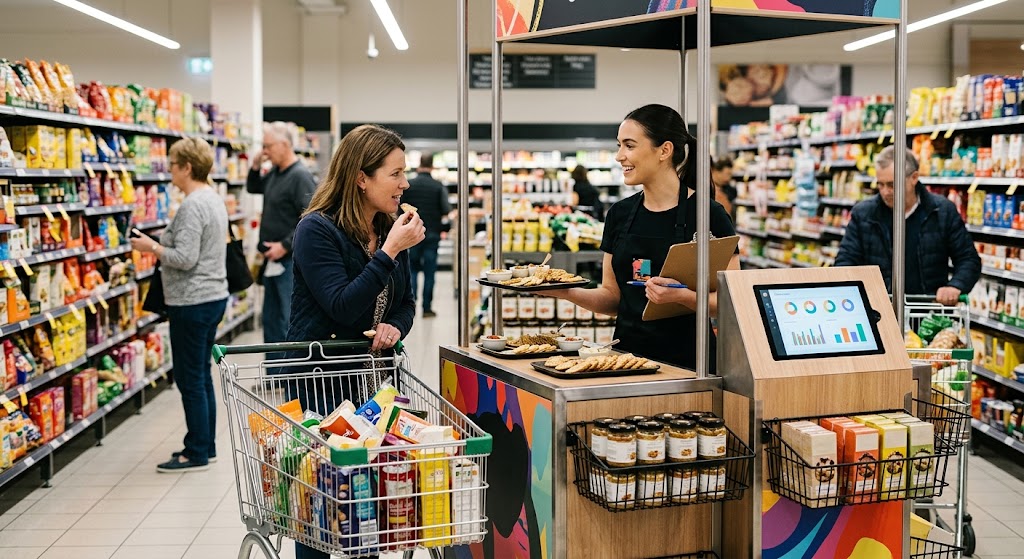
Measuring the ROI of a Brand Activation at the Point of Sale means calculating the difference between the net revenue generated by the campaign and the total cost of execution, dividing it by the overall investment and multiplying by one hundred. To obtain an accurate figure, brands must account for the direct increase in sales (sales lift), the in-store conversion rate, the number of samples handed out and the customer data captured (leads). Combining direct financial metrics with long-term brand value indicators ensures a complete calculation of advertising return in the physical channel.
At Grupo WDi, as specialists in retail marketing strategies, we know that measuring financial impact turns experiential campaigns into predictable investments. Evaluating every action in the retail space makes it possible to optimise the budget and maximise financial performance.
How do you measure the ROI of a brand activation at the point of sale?
Assessing the profitability of retail activity requires a structured approach that combines immediate financial data with brand perception metrics. Simply observing footfall is not enough; it is essential to track how that traffic turns into real revenue for the company.
Calculating the financial return means comparing sales volume during and after the activation against a baseline control period. This comparison helps isolate the campaign’s own impact from external factors such as market seasonality.
For accurate measurement, brands must add up all the fixed and variable costs of the project. These include producing the displays, venue hire, logistics, integrated technology and the cost of the staff involved.
Basic formula and key conversion metrics
The standard formula consists of subtracting the cost of the activation from the gross earnings it generated, dividing the figure by the total cost and multiplying the result by 100. A positive percentage indicates a profitable return for the business.
ROI = ((Net activation earnings − Total activation cost) / Total activation cost) × 100
Beyond strict financial ROI, it is worth analysing ROAS (return on ad spend) and customer lifetime value (LTV). These variables reveal whether shoppers recruited in store go on to buy the brand repeatedly.
Benchmarks to set before the retail activation
Before installing any structure or launching an experiential activity, you must establish the store’s sales baseline. Knowing your product’s average daily rate of sale under normal conditions lets you quantify the real uplift attributable to the campaign.
Define clear, achievable key performance indicators (KPIs) before you start. Assign numerical values to goals such as the percentage increase in transactions, the interaction rate with displays and the volume of new registrations collected.
Choosing the right technology tools for data capture simplifies later analysis. Information collected in real time guides decision-making for future activity across the store network.
Data capture through interactive technology
Building digital tools into the physical infrastructure speeds up the collection of data on consumer behaviour. People counters, heat maps and personalised QR codes measure audience interest with complete accuracy.
An effective way to increase interaction is to integrate interactive point-of-sale screens that record customer preferences as they browse the latest products in the range.
Technology also provides valuable metrics on average dwell time at the stand. The greater the physical interaction with the brand, the higher the conversion rate at the till tends to be.
To learn more about how innovation enhances in-store analytics, read our article on point-of-sale digitalisation.
Sales attribution and immediate impact on the shelf
Analysing sales performance in the weeks after the campaign reveals the level of recall the brand achieved. A good activation generates an initial spike in purchases and sustains a rate of sale above the usual average.
You should monitor channel performance continuously to check that growth is not simply regular customers bringing their purchases forward. Real success lies in winning shoppers from competitors.
Always compare the stores where you ran the activation with similar stores where no activity took place. This control group objectively validates the financial performance attributable to the campaign.
Optimising physical presence with large formats
The visual design of the space directly determines the number of impressions achieved in the main aisle. Spectacular, well-placed structures ensure a higher percentage of passers-by stop and interact.
If you want to maximise visibility and generate a high volume of direct impressions, discover the strategic advantages of point-of-sale macro-displays within marketing plans.
A functional, attractive design not only increases the visitor capture rate but also reinforces the company’s image of leadership on the shop floor.
Evaluating the team and its conversion rate
The staff running the stand have a direct influence on the financial return. Promoters’ sales skills turn a passer-by’s initial interest into a completed transaction.
Measuring staff performance means analysing the number of interactions started, the demonstrations carried out effectively and the proportion of people who bought the product after the explanation.
Investing in prior training enables the team to convey the brand’s values fluently and handle common objections at the point of contact.
In-store staff performance and roles
Supervising the sales team ensures the service protocol is carried out without deviation. A proactive attitude from professionals multiplies the value of any physical advertising investment.
If you want to select the right profiles to boost your in-store sales, we suggest reading about the strategic role of the sales promoter in retail.
A well-prepared team makes the most of service time and ensures that every sample or leaflet handed out ends up with a customer with high purchase potential.
Analysing overall costs for an accurate ROI
A common mistake when calculating campaign profitability is leaving out indirect costs during the financial close. To obtain a real figure, every expense must be documented in the final balance.
Take into account graphic design, production of fixtures, municipal or commercial permits, transport, and the logistics of installing and dismantling the stand. Also add any incentives or free samples handed out during the activation.
Subtracting all of these costs from the gross margin generated by the additional sales will reveal the exact net profit contributed by the in-store marketing strategy.
Professional installation and budget control
Avoiding delays or errors during roll-out protects the allocated budget and prevents unexpected cost overruns. Precise logistical coordination ensures operational deadlines are strictly met.
To ensure clean execution that respects the agreed financial plan, it is advisable to hire a specialist service for professional point-of-sale installation.
An installation carried out correctly from the very first minute prevents operational stoppages that reduce the time available to generate sales during the campaign.
Qualitative value and long-term return
Although financial ROI measured in money is the main metric for management, qualitative value brings lasting strategic benefits to the company.
Improved brand perception, gaining preferential space on the retailer’s shelves and customer loyalty are highly valuable assets that pay off for months.
Including these achievements in the final results report demonstrates the holistic impact of in-store activity on the overall health of the business.
Integration with retail architecture and space
Visual consistency between the stand and the corporate identity raises the company’s prestige in the eyes of consumers. An attractive space creates a lasting memory that influences future purchase decisions.
If you want to transform the in-store experience of your premises permanently, we invite you to explore how retail architecture influences sales performance.
Designing functional, dynamic retail environments encourages continuous interaction with shoppers and increases the store’s long-term profitability.
Frequently asked questions
What is an acceptable ROI for a point-of-sale activation?
An acceptable ROI for in-store campaigns is usually above 20% to 30% in net profit. However, for new product launches, achieving a break-even ROI (0%) in the first phase is considered a success if it brings in a high number of new customers.
How can I measure sales if the customer buys days after the activation?
You can use exclusive discount vouchers handed out at the activation with a specific code, or track the average increase in in-store rate of sale over the four weeks after the event compared with the baseline period.
What technology helps measure footfall without invading privacy?
Infrared people counters, heat-mapping systems using non-recording cameras and anonymous touchscreen interaction metrics make it possible to evaluate visitor flow while strictly complying with data protection regulations (GDPR).